
July 8, 2026
In February 1900, the presidents of Johns Hopkins, Columbia, Harvard, Cornell, Yale, Clark, Catholic University, Princeton, Stanford, and the Universities of Chicago, Pennsylvania, California, Michigan, and Wisconsin met in Chicago to create the American Association of Universities (AAU), an organization dictated to “matters of common interest relating to graduate study.” [1]
Graduate education had been maturing in the United States over the previous four decades, as students, professors, and administrators began adopting “scientific” educational models pioneered in Germany, though adapting them to a far less centralized and state-controlled environment. [2]
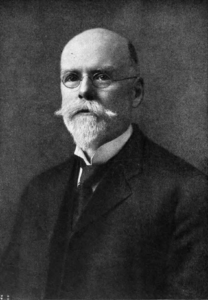
William Archibald Dunning
Columbia was an early entrant. Its School of Political Science was founded in 1880 by John W. Burgess, a pioneering academic (and proud white supremacist). [3] Among its first students was William Archibald Dunning, who earned his B.A. (1881), M.A. (1884), and Ph.D. (1885) from the institution. Dunning went on to serve as a professor at Columbia for forty years. He also served as president of the American Historical Association and the American Political Science Association. [4] Influenced by Burgess, Dunning’s graduate work, and later his professional work, were almost exclusively devoted to the study of Reconstruction, [5] with Reconstruction, Political and Economic, 1865-1877 (1907) his central document. But Dunning’s most significant contribution was as mentor and guide to a generation of scholars on the topic, including U.B. Phillips, Walter Lynwood Fleming, [6] Charles W. Ramsdell, James W. Garner, Joseph G. deRoulhac Hamilton, and a further focus of this study, C. Mildred Thompson, who would go on to serve as dean of Vassar College. This group is today known collectively as The Dunning School. According to W. E. B. Du Bois’ accounting and description, the Dunning scholars were responsible for 16 studies of Reconstruction in former Confederate states published between 1895 and 1935, all produced using the same methods and carrying the same thesis: “first, endless sympathy with the South; second, ridicule, contempt or silence for the Negro; third, a judicial attitude towards the North … [which] eventually saw its mistake and retreated.” [7]
Du Bois did note that Dunning as a writer was “less dogmatic” than his mentors and students. But the influence of his times, particularly its racial assumptions, combined with the growing demand to produce scholarship on an industrial scale, provided little incentive to temporize. In the Preface to Reconstruction, Political and Economic, 1865-1877, Dunning, inadvertently perhaps, highlighted the trend in historical production from patron funded studies to institutionally funded studies when he acknowledged the intellectual but not material contribution to his Reconstruction by Dr. James Ford Rhodes, a wealthy industrialist who retired to “write” history, by, according to Du Bois, “gather[ing] a vast number of authorities, [and selecting] those whose testimony supported his thesis” (715). [8]
The transition Dunning and others like him initiated was to professionalize and make “scientific” the process of history production, and to make it the work of universities. As one writer notes, “[the] fusion of the scientific method and historiography, paralleled … the similar merging of evolutionary biology and race theories,” with both ultimately validating white supremacy. [9] Dunning’s Reconstruction can be read as a demonstration of method as much as it can be read as a work of original scholarship. But neither, perhaps, is as important as the text’s positioning. Throughout the book, the author, from his respected position at Columbia, validated white supremacy. For example, in Dunning’s defense of the “Black Codes:”
The freedmen were not, and in the nature of the case could not for generations be, on the same social, moral, and intellectual plane with the whites; and this fact was recognized by constituting them as a separate class in the civil order … The restrictions in respect to bearing arms, testifying in court, and keeping labor contracts were justified by well-established traits and habits of the negroes … [10]
Casually, repeatedly, and dismissively, Dunning categorized black Americans as “ignorant and degraded black men,” “ignorant blacks,” and “ignorant freedmen,” [11] all easily manipulated by outsiders with rapacious motives. He viewed black personhood as little more than a Radical Republic fantasy, a weapon of guilt to be wielded in order to gain and maintain power. Few passages communicate this more clearly than his report on the massacre at Colfax, which he labeled “the affair at Colfax.” Rather than demonstrating the need to maintain a federal presence in order to protect black Americans, or simply as a tragedy for blacks, Dunning dismissively positioned the massacre as a final farce, “display[ing] to the North the reductio ad absurdum of reconstruction through negro suffrage and a regime of carpet-baggers.” [12]
Dunning’s book is in fact a transitional document. He includes a reasonably thorough final chapter titled “Critical Essay on Authorities,” but his footnoting is sparse and his sources few. The same is not true of his seminar students. Building on the work of Dunning and his mentor, John Burgess, students like C. Mildred Thompson, who published her dissertation in 1915, just eight years after Dunning published Reconstruction, demonstrate a significant evolution in the formality of academic presentation expected from Columbia.
Thompson is the only woman generally associated with the Dunning school. She was born in Atlanta in 1881 and attended public school there before enrolling at Vassar College, where she would later serve as president. Du Bois noted that her monograph, “Reconstruction in Georgia, Economic, Social, Political,” was “another case in point” compared to the work of her peers, as it sought to be “fair.” [13] As stated, from a technical standpoint and as a reflection of “modern” academic methodology and presentation, Thompson’s work reflects the rapid evolution of scholarship at Columbia. William Harris Bragg, in an essay published in The Dunning School (2013), calls Thompson “a liberal among the Dunningites.” [14] Relatively, perhaps, she was.
“Reconstruction in Georgia” outlines the significant economic and political issues that arose from the sudden emancipation of enslaved people and the disruption that event generated within the economy, particularly in the year following the Civil War. She notes several of the significant accomplishments of the Reconstruction government, including schools and hospitals. And in her conclusion, Thompson demonstrates a sympathy for efforts at reconstruction, wrenching though it may have been, writing:
No society, in which one-half of the members were slaves, could be democratic in any nineteenth century meaning of the term. The extension of “the people” to include the black half as well as the white half of the population, was a great step forward toward the real republic of which Georgia made a part. [15]
Thompson also made a plea for understanding, or at least some moderation in moral judgement from those who did not live through the experience, writing in her closing sentence, “As in most great changes, the benefits are enjoyed vicariously. Those who pay the price do not enjoy the product.” [16] And touching on emotional truths, not mere economics, Thompson wrote, “The emergence of the negro as a free laborer created a rival to the poor white man from which slavery had in a great measure protected him.” [17]
Yet, Thompson’s text is replete with stories of “lazy,” “idle,” and “loafing negroes.” As Du Bois notes, “silly stories about Negroes indicating utter lack of even basic common sense.” The text includes a half-dozen examples of demeaning “jokes,” always presented in minstrel-show dialect. [18] The desire to experience freedom is heckled as “wanderlust.” Even the eagerness “to have a home, a mule, cow and hogs set apart from the others” is characterized as a racial trait of being “[u]nambitious of accumulating capital.” [19]
Public awareness and enthusiasm for the central tenets of the Dunning school reached its apotheosis with the publication of The Tragic Era in 1929. Written by Claude G. Bowers, a reporter and political operative, The Tragic Era dispensed with all academic moderation to tell a highly charged tale of Reconstruction bundled as a popular history, but more in the mode of D. W. Griffith’s Birth of a Nation than Dunning’s Reconstruction, Political and Economic, 1865-1877. Reporting, for example, a story of the Florida state constitutional convention, Bowers claimed, illiterate black delegates, “having no taxes to pay and no stake in the State,” lounged with their feet on desks as they partook in graft and debauchery. [20] The Tragic Era was an instant best-seller, picked up as a regular selection of the Literary Guild, and went through thirteen hardbound editions before being published as a paperback in the late 1950s. As of 1977, the book had never been out of print. Interestingly, though Bowers is listed in many online sources as a Dunningite, [21] “Dunning’s most infamous student” [22] and among “Representatives of the Dunning School,” [23] he never attended Columbia. In fact, barely finished high school.
Perhaps Bowers’ academic bona fides do not matter. After all, the Dunning school itself did not originate the thesis upon which its work rested. That thesis, as described by Du Bois, particularly its “contempt or silence for the Negro,” had been adopted as conventional wisdom by Dunning’s mentor John Burgess, as well as John Rhodes, Susan Pendleton Lee, and virtually all other white historians of the period. In fact, its central tenet, its “contempt” for and an associated hyper-reaction to any attempt at black agency in the United States, or willful ignorance of such efforts, of course predates Reconstruction itself.
References
[1] Qtd. in Nerad, Maresi, “Graduate Education in the United States,” in Contemporary Higher Education: Graduate Education in the United States (New York: Garland Press,) 1997, iv.
[2] John R. Thelin, Jason R. Edwards, and Eric Moyen. “Higher Education in the United States.” in Education Encyclopedia (StateUniversity.com Education Encyclopedia), https://education.stateuniversity.com/pages/2044/Higher-Education-in-United-States.html, accessed May 1, 2022.
[3] Nicholas Hallock, “An ‘Apostle of Reaction’ on the Hudson Shore: John W. Burgess, Reconstruction, and the Birth of the American University,” https://columbiaandslavery.columbia.edu/content/apostle-reaction-hudson-shore-john-w-burgess-reconstruction-and-birth-american-university, accessed May 1, 2022.
[4] See: Louis Menand, Paul Reitter, and Chad Wellmon (eds.), The Rise of the Research University: A Sourcebook (Chicago: The University of Chicago Press), 2017.
[5] See: Patrick Young, “Remembering Racist Historian of Reconstruction William Dunning at His Columbia University Alma Mater,” The Reconstruction Era (blog). July 20, 2019, https://thereconstructionera.com/remembering-racist-historian-of-reconstruction-william-dunning-at-his-columbia-university-alma-mater/, accessed May 1, 2022.
[6] Although Fleming is listed as a student of Dunning, Dunning cited Fleming more than three dozen times in Reconstruction.
[7] Du Bois, Black Reconstruction, 719.
[8] William Archibald Dunning, Reconstruction: Political and Economic, 1885-1877 (New York: Harper & Brothers Publishers), 1907, 715. Rhodes views on race were influenced, and he thought made ‘scientific,’ by Louis Agassiz, known to historians as the last major biologist to not accept Darwin’s theory of natural selection. In Mismeasure of Man, author Stephen Jay Gould relates the “visceral revulsion” Agassiz felt when he first encountered an American of African descent. Rhodes quotes Agassiz at length from a letter Agassiz wrote in 1868 to Dr. Samuel G. Howe, sharing advice he thought Howe should share if he had the opportunity to speak to his friend, Charles Sumner, one of the leaders of the Radical Republicans: “We should beware how we give to the blacks rights, by virtue of which they may endanger the progress of the whites before their temper has been tested by a prolonged experience. Social equality I deem at all times impracticable, – a natural impossibility, from the very character of the negro race.” See: Stephen Jay Gould, The Mismeasure of Man (New York: W. W. Norton & Company), 1996, 76; Rhodes, James Ford Rhodes, History of the United States: Vol. VI, 1866-1872 (New York: The Macmillan Company), 1920, 148.
[9] Young, The Reconstruction Era, 2019.
[10] Dunning, Reconstruction, 1907, 58.
[11] See: Dunning, Reconstruction, 175, 308, and 184 respectively.
[12] Ibid, 219.
[13] C. Mildred Thompson, “Reconstruction in Georgia: Economic, Social, Political, 1865-1872,” PhD diss, (Columbia University), 1915, 720.
[14] Eric, J. Foner, Vincent Lowery, and John David Smith, The Dunning School: Historians, Race, and the Meaning of Reconstruction (Lexington: The University Press of Kentucky), 2013, 281-308, muse.jhu.edu/book/27052.
[15] Thompson, Reconstruction in Georgia, 401
[16] Ibid.
[17] Ibid, 130.
[18] See examples: Thompson, Reconstruction in Georgia, 81, 129.
[19] Ibid, 294.
[20] Claude E. Bowers, The Tragic Era: The Revolution after Lincoln (Cambridge: Houghton Mifflin Company), 1957, 216-17.
[21] See: http://digital.lib.lehigh.edu/trial/reels/films/list/0_68_8_6106, accessed May 1, 2022
[22] See: https://unm-historiography.github.io/metahistory/essays/modern/The-Dunning-School-of-Thought.html, accessed May 1, 2022.
[23] See: https://en.wikipedia.org/wiki/Dunning_School, accessed April 30, 2022.