William Dunning and the Dark Roots of Academic History
July 8, 2026
In February 1900, the presidents of Johns Hopkins, Columbia, Harvard, Cornell, Yale, Clark, Catholic University, Princeton, Stanford, and the Universities of Chicago, Pennsylvania, California, Michigan, and Wisconsin met in Chicago to create the American Association of Universities (AAU), an organization dictated to “matters of common interest relating to graduate study.” [1]
Graduate education had been maturing in the United States over the previous four decades, as students, professors, and administrators began adopting “scientific” educational models pioneered in Germany, though adapting them to a far less centralized and state-controlled environment. [2]
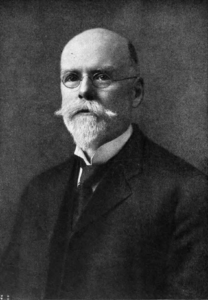
William Archibald Dunning
Columbia was an early entrant. Its School of Political Science was founded in 1880 by John W. Burgess, a pioneering academic (and proud white supremacist). [3] Among its first students was William Archibald Dunning, who earned his B.A. (1881), M.A. (1884), and Ph.D. (1885) from the institution. Dunning went on to serve as a professor at Columbia for forty years. He also served as president of the American Historical Association and the American Political Science Association. [4] Influenced by Burgess, Dunning’s graduate work, and later his professional work, were almost exclusively devoted to the study of Reconstruction, [5] with Reconstruction, Political and Economic, 1865-1877 (1907) his central document. But Dunning’s most significant contribution was as mentor and guide to a generation of scholars on the topic, including U.B. Phillips, Walter Lynwood Fleming, [6] Charles W. Ramsdell, James W. Garner, Joseph G. deRoulhac Hamilton, and a further focus of this study, C. Mildred Thompson, who would go on to serve as dean of Vassar College. This group is today known collectively as The Dunning School. According to W. E. B. Du Bois’ accounting and description, the Dunning scholars were responsible for 16 studies of Reconstruction in former Confederate states published between 1895 and 1935, all produced using the same methods and carrying the same thesis: “first, endless sympathy with the South; second, ridicule, contempt or silence for the Negro; third, a judicial attitude towards the North … [which] eventually saw its mistake and retreated.” [7]


 Reconstruction was a decade-plus (1863-1877) effort by the U.S. government to manage the readmission to the Union of states that had rebelled during the Civil War, with specific demands by Congress to enfranchise and empower the 4,000,000 formerly enslaved people who resided in those states. It succeeded, but only temporarily.
 Evidently, the “new” cause of tech millionaires and billionaires like Peter Thiel, Marc Andreessen, and Elon Musk is the survival of our species, at any cost, until it reaches a “transhuman” plane. Once reached, humans, or I guess post-humans, will push out into the universe physically and virtually for the next 10e100 years, and perhaps beyond.